Calculus Third Edition

PDF files should be printed before use.

1.5.1How do position and velocity relate?

Area and Slope

1-190.

FREDO AND FRIEDA RETURN

Fredo and Frieda each recorded data for a different race, as shown below. This time the students are not so sure their data matches. The coach has turned to you for help. Decide which student measured distance and which measured velocity. Identify ways to decide if the graphs represent the same data. Be prepared to share your methods to confirm whether the data collected by each student matches the others.

Fredo’s Graph
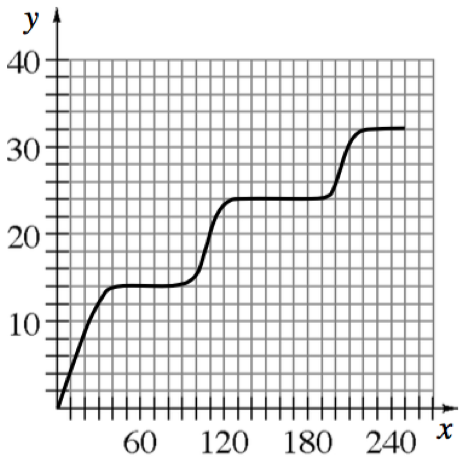
First quadrant continuous curve, with approximate turning points as follows: starting at the origin, turning right at (45, comma 14), turning up at (105, comma 15), turning right at (120, comma 24), turning up at (210, comma 25), turning right at (225, comma 34).

Frieda’s Graph

First quadrant increasing curve, opening up, starting at the origin, passing through the approximate points (120, comma 900), & (240, comma 4200).

1-191.

College Admissions Writing Prompt

Liebniz University in Newton, North Calculina has a unique requirement for math majors. In order to receive credit for scoring well on the AP Calculus exam, students must demonstrate understanding of the following topic through a formal essay.

Please respond to the following prompt. Note: If you include graphs to illustrate your ideas, make sure they are well labeled.

What is the relationship between position and velocity?
 

  • How can velocity information be determined from a position graph? What about speed?
     

  • How can position information be determined from a velocity graph?
     

Be sure to draw distinctions between actual position, displacement, and total distance. What extra information do you need to determine actual position from a velocity graph?

1-192.

So far in this chapter, you have determined information about acceleration and distance from a velocity graph. You have developed ways to calculate total distance or displacement. Now, we want to write a function for the distance over time. Using the graph below:

First quadrant, x axis labeled time, seconds, y axis labeled velocity, feet per seconds, continuous linear piecewise, starting at the origin, rising until (2, comma 4), then running horizontally right.

  1. Write a piecewise-defined function for the velocity graph.

  2. Copy and complete the table below for distance traveled over time. Assume that d(0)=0

    t

    0

    0.5

    1

    1.5

    2

    3

    4

    5

    6

    d(t)

    4

    20

  3. Plot the distance verses time graph y=d(t) from the table completed in part (b).

  4. Write the piecewise-defined function for the distance versus time graph.

1-193.

A particle is moving along a straight line. The velocity of the particle is shown on the graph below.

Unscaled axes, with curve starting at the origin, rising to point, A, about half up in first quadrant, passing through the x axis at point B, falling twice as far as it rose, to point C, rising & passing through point D, & point E at the x axis, continuing up & right.

  1. At what point is the velocity greatest?

  2. At what point is the speed greatest?

  3. Where does the particle change from moving forward to moving backward?

  4. Where is the acceleration positive?

Review and Preview problems below

1-194.

NOT AGAIN!

Theo has done it again. Before he lost his graph, he used it to determine the following properties of his motion. Help him re-create a possible graph of this motion. Homework Help ✎

Details:

  • He changed directions three times during his 8-foot walk.

  • His average velocity was 0 feet per second.

  • Theo walked for 6 seconds and started 5 feet from the motion detector.

1-195.

Carefully graph f(x)={x for 0<x<4(x6)22 for 4x<10on your paper. Then, write a detailed slope statement. 1-195 HW eTool. Homework Help ✎

1-196.

Given the tables below: 1-196 HW eTool. Homework Help ✎

x

2

1

0

1

2

3

10

100

f(x)

11

8

5

2

1

4

25

295

x

3

2

1

0

1

2

3

12

g(x)

5

0

3

4

3

0

5

140

x

2π

π

0

π2

π

3π2

2π

12π

h(x)

2

2

2

0

2

0

2

2

  1. Write possible equations for the functions f, g, and h.

  2. Evaluate:

    1. f(g(h(π)))

    2. h(g1(4))

    3. f1(h(π))

1-197.

The population of Smalltown on January 1st for 5 years is shown in the table at right. Homework Help ✎

  1. Write a slope statement for the given data.

  2. Calculate the average rate of change per year in the population between 2011 and 2015.

  3. Approximate the rate of change of the population on January 1st, 2014. Explain how you got your answer.

2011

2300

2012

2415

2013

2536

2014

2663

2015

2796

1-198.

Draw two different distance graphs that each has an average velocity of 5 meters per minute. 1-198 HW eToo. Homework Help ✎

1-199.

The area between the x-axis and f(x)=|x3|+5  forms a flag. Calculate the volume of the solid generated when this flag is rotated about the x-axis. Homework Help ✎

1-200.

Write the equations of two non-trivial functions f and g such that f(g1(x))=3x2+6 . Homework Help ✎

1-201.

Shehazana, who is 5.5 feet tall, is walking toward a 20-foot tall streetlight. Write an equation for the length of her shadow, x, in terms of the distance, d, she is from the pole. Visualize this situation using the 1-201 HW eToo. Homework Help ✎

Right triangle, vertical leg shown as a light pole, labeled 20 feet, hypotenuse is dashed, horizontal segment, between hypotenuse & horizontal leg, shown as a person running, divides horizontal leg into 2 unequal parts, left section labeled, d, right section labeled, x.

1-202.

State the domain of each of the following functions. Homework Help ✎

  1. f(x)=sec(x)

  2. g(x)=log(x2+1)

  3. h(x)=x24x2x6

  4. k(x)=log(x1)x216

1-203.

Multiple Choice: When the graph of f(x)=12x is reflected across the y-axis, the equation of the resulting graph is: Homework Help ✎

  1. g(x)=10.5x

  1. g(x)=1+2x

  1. g(x)=2x1

  1. g(x)=log2(x1)

  1. g(x)=log2(1x)